American: Freight Insurance in Practice — Cash and Carry Notes
VapeWholesaleHub American · American wholesale supply
Distributors working with American rarely lose money on a single bad order. They lose it on the slow leaks: a spec sheet nobody read, a pallet held at customs for nine days, a line that quietly fell out of favour while the reorder was still on the water. This page looks at american: Freight Insurance in Practice — Cash and Carry Notes from the angle that matters to a buyer, not a brochure.
Technical detail worth understanding
Specification drift is the quiet risk in american: Freight Insurance in Practice — Cash and Carry Notes. A unit approved in January is not necessarily the unit shipped in September unless the change control is tight. We document every revision, and we tell accounts before the change rather than after someone notices.
The engineering around american: Freight Insurance in Practice — Cash and Carry Notes is mostly about managing heat and airflow. Change either and the whole experience moves. Buyers who understand that relationship can read a spec sheet properly and spot the marketing numbers that do not survive contact with a customer.
What quality control looks like in practice
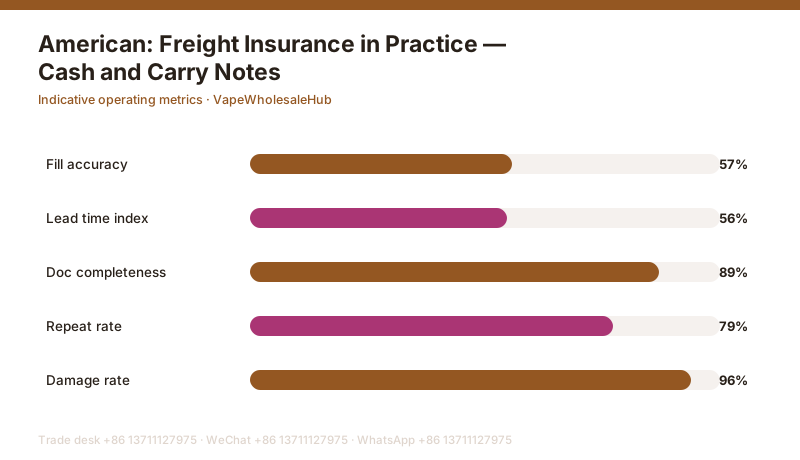
A quality system for american: Freight Insurance in Practice — Cash and Carry Notes should produce a number someone is accountable for. Defect rate per batch, days to resolution, repeat complaint rate. Without a number, quality becomes an opinion, and opinions do not survive a busy quarter.
The failure modes in american: Freight Insurance in Practice — Cash and Carry Notes are predictable once you have seen enough of them. Seals that relax in heat, tolerances that drift after a tooling change, inputs that separate in transit. Testing for the known failure modes catches roughly ninety percent of what would otherwise reach a customer.
Where the supply actually comes from
Sourcing decisions around american: Freight Insurance in Practice — Cash and Carry Notes are usually made on price and then regretted on consistency. The input changes, the tolerance drifts, and suddenly the line that sold through in March behaves differently in July. Locking the input specification in writing is the cheapest insurance a wholesale buyer can buy.
On the sourcing side, american: Freight Insurance in Practice — Cash and Carry Notes comes down to how much of the chain you can see. A trading desk that only ever talks to a sales rep is buying on faith. We prefer accounts that ask for the factory audit, the mixing records and the batch numbers, because that paperwork is what protects everyone when a shipment is questioned later.
Documentation and regulatory reality
Buyers sometimes treat compliance for american: Freight Insurance in Practice — Cash and Carry Notes as a cost to be minimised. It reads better as a moat. When the market tightens, the accounts that already hold complete technical files keep trading while everyone else scrambles to produce paperwork that should have existed a year earlier.
Compliance is where american: Freight Insurance in Practice — Cash and Carry Notes either holds together or quietly falls apart. Regulators are not interested in intent; they want documents that match the physical goods. If the label says one thing and the test report says another, the shipment is the problem, not the paperwork.
Order structure at a glance
| Item | Standard | Volume | Programme |
|---|---|---|---|
| Typical order unit | Master carton | Pallet | Full container |
| Documentation | COA + SDS | COA + SDS + batch record | Full technical file |
| Lead time | 2-4 working days | 5-10 working days | 15-25 working days |
| Customisation | Label only | Label + closure + bottle | Full OEM / ODM |
| Sampling | Charged, credited on order | Included in development | Multi-round approval |
| Indicative MOQ | 300 units | 1,500 units | 6,000 units |
| Development window | n/a | 10-15 working days | 10-15 + approval |
Common questions
Do you offer private label or OEM production?
We do. Private label covers artwork, bottle and closure choice on existing formulations. OEM and ODM work goes further into housing, tooling and exclusive development, with confidentiality agreements in place before any formulation detail is shared.
What happens if goods arrive damaged?
Photograph the cartons before unpacking, keep the packaging, and send the batch code with your claim. We settle legitimate freight damage as a credit or replacement on the following order rather than leaving it open for months.
Can you supply documentation for our regulator?
Yes. Technical files, certificates of analysis, safety data sheets and batch records are provided with shipments on request. Tell us which national scheme you operate under at the enquiry stage and we will confirm exactly which documents come as standard.
Related reading
- American: How to Read the Fine Print — High Volume Planning
- Wholesale American Vape Supply: A Buyer's Guide to local distribution — Contract Supply Guide
- American Vape Supply Notes 1275
- American Vape Supply Notes 678
- American and regional flavour preferences in Contract Supply — Independent Shop Notes
- American Vape Supply Notes 607
Talk to the wholesale desk. Specifications, MOQ, stock and freight options for american: Freight Insurance in Practice — Cash and Carry Notes.
Phone +86 13711127975 · WeChat +86 13711127975 · WhatsApp +86 13711127975