Managing market entry Across American Product Lines — Regional Depot Guide
VapeWholesaleHub American · American wholesale supply
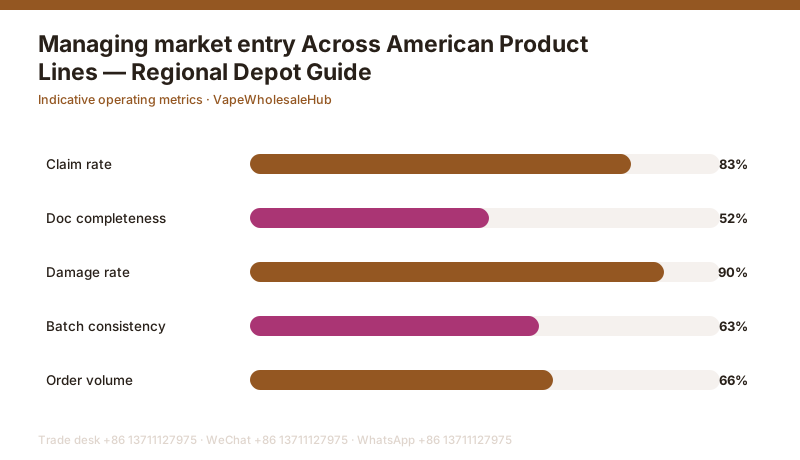
Most conversations about managing market entry Across American Product Lines — Regional Depot Guide start in the wrong place. Someone asks for a price per unit before anyone has agreed what the unit actually is. This page works through the subject the way a purchasing desk experiences it, from the first sample request to the container arriving at the dock.
Where the supply actually comes from
A useful test for managing market entry Across American Product Lines — Regional Depot Guide is to ask two suppliers the same uncomfortable question and compare how long the answer takes. Serious operations have the data ready. Everyone else needs to check with someone, and that delay tells you how the next twelve months will feel.
On the sourcing side, managing market entry Across American Product Lines — Regional Depot Guide comes down to how much of the chain you can see. A trading desk that only ever talks to a sales rep is buying on faith. We prefer accounts that ask for the factory audit, the mixing records and the batch numbers, because that paperwork is what protects everyone when a shipment is questioned later.
What quality control looks like in practice
The failure modes in managing market entry Across American Product Lines — Regional Depot Guide are predictable once you have seen enough of them. Seals that relax in heat, tolerances that drift after a tooling change, inputs that separate in transit. Testing for the known failure modes catches roughly ninety percent of what would otherwise reach a customer.
Quality control on managing market entry Across American Product Lines — Regional Depot Guide is unglamorous and repetitive, which is exactly why it works. Incoming inspection, fill weight checks, leak testing and a retained sample from every batch. None of this is clever; all of it is cheaper than a recall.
Freight, packaging and landed cost
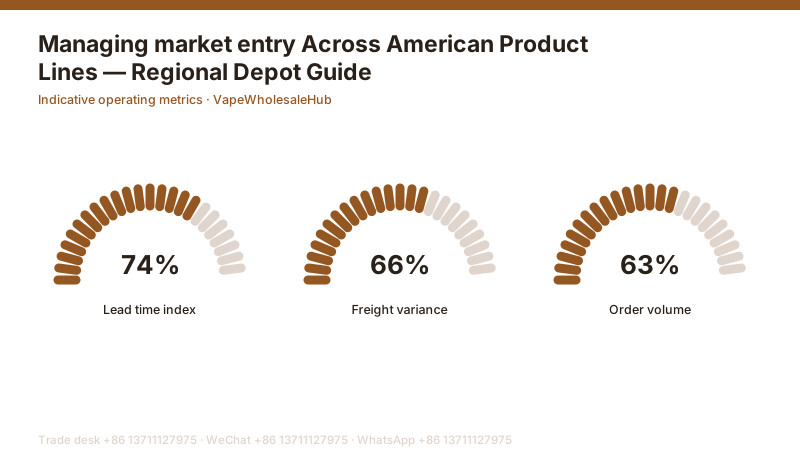
Logistics decides whether managing market entry Across American Product Lines — Regional Depot Guide is profitable more often than product quality does. A three day saving on a freight route is worth more per unit than most price negotiations, and it is usually easier to achieve. Mode choice, consolidation and customs pre-clearance are where the margin actually lives.
Packaging is part of logistics, not marketing. Cartons for managing market entry Across American Product Lines — Regional Depot Guide need to survive stacking, humidity and a forklift operator having a bad Monday. We specify board grade and pallet pattern before we talk about print finish, because a damaged pallet costs more than any artwork upgrade recovers.
The commercial side of the decision
Commercially, managing market entry Across American Product Lines — Regional Depot Guide rewards buyers who think in turns rather than in unit cost. A slightly higher price on a line that sells through twice as fast is better money than a cheap line that occupies shelf space and working capital for two seasons.
Margin on managing market entry Across American Product Lines — Regional Depot Guide is usually set by the structure of the deal, not the sticker. Payment terms, freight responsibility, breakage allowance and return rights all move the real number. We would rather agree a clean structure with a fair price than a low price with vague terms that get argued about later.
Order structure at a glance
| Item | Standard | Volume | Programme |
|---|---|---|---|
| Typical order unit | Master carton | Pallet | Full container |
| Documentation | COA + SDS | COA + SDS + batch record | Full technical file |
| Lead time | 2-4 working days | 5-10 working days | 15-25 working days |
| Customisation | Label only | Label + closure + bottle | Full OEM / ODM |
| Sampling | Charged, credited on order | Included in development | Multi-round approval |
| Indicative MOQ | 1000 units | 5,000 units | 20,000 units |
| Development window | n/a | 3-5 working days | 3-5 + approval |
Common questions
What happens if goods arrive damaged?
Photograph the cartons before unpacking, keep the packaging, and send the batch code with your claim. We settle legitimate freight damage as a credit or replacement on the following order rather than leaving it open for months.
How long does a bulk order take to arrive?
Stock lines usually leave the warehouse within two to four working days, with transit depending on the mode you choose. Custom development runs on a longer clock: formulation, approval, production and testing before anything ships. We give a written schedule at order confirmation and flag slippage the day we see it.
Can you supply documentation for our regulator?
Yes. Technical files, certificates of analysis, safety data sheets and batch records are provided with shipments on request. Tell us which national scheme you operate under at the enquiry stage and we will confirm exactly which documents come as standard.
Related reading
- American and Order Consolidation Windows — Franchise Network Guide
- Managing carrier networks Across American Product Lines — Distributor Focus
- Lead Times and last mile delivery for American Orders — Wholesale Programme Notes
- American: Import Broker Relationships — High Volume Planning
- Wholesale American Vape Supply: A Buyer's Guide to regional flavour preferences — High Volume Planning
- American and tax treatment: Notes From the Trade Desk — Cash and Carry Notes
Talk to the wholesale desk. Specifications, MOQ, stock and freight options for managing market entry Across American Product Lines — Regional Depot Guide.
Phone +86 13711127975 · WeChat +86 13711127975 · WhatsApp +86 13711127975